
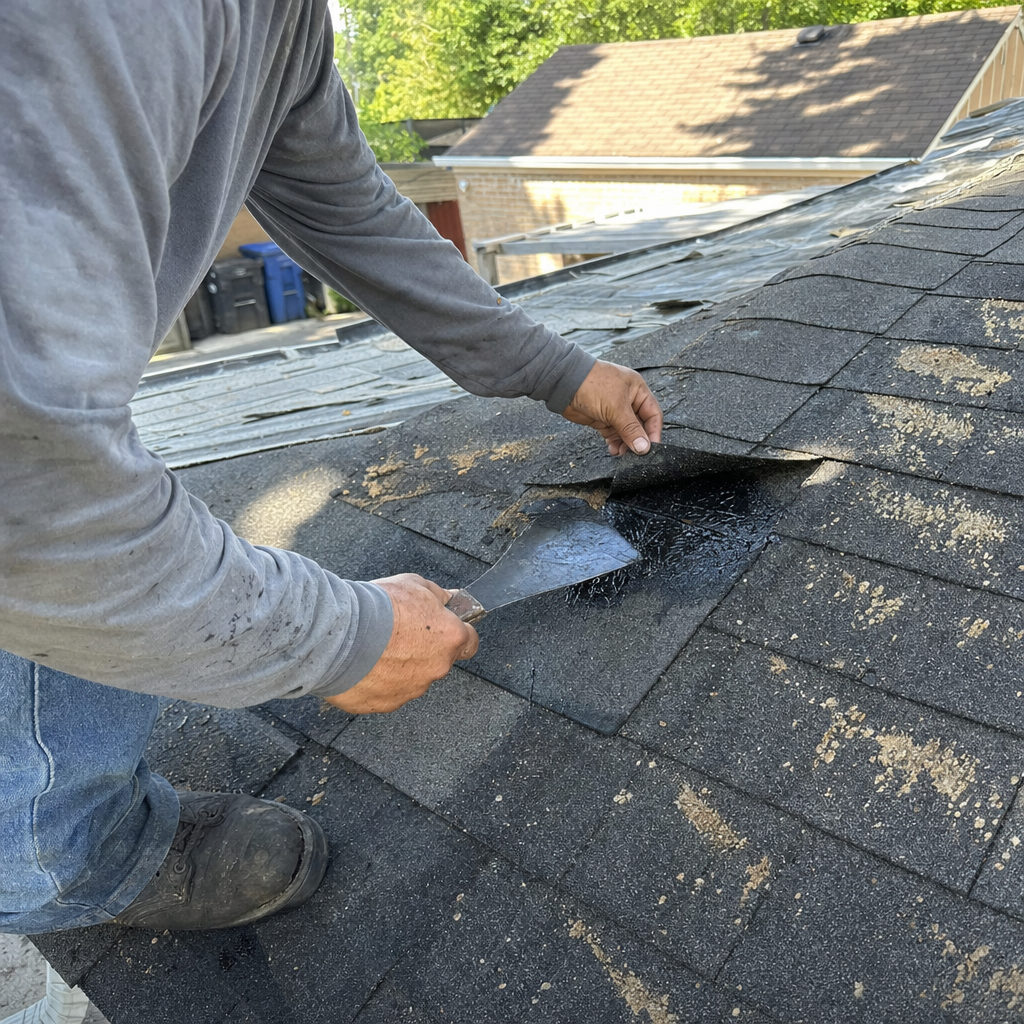
Tamko Flashing Replacement: The Chicago Owner’s Guide
Tamko flashing replacement in Chicago typically runs $340-$780 installed, depending on whether we’re talking about a simple pipe boot or a full chimney saddle with step flashing. We stock Tamko-compatible galvanized steel and aluminum flashing in common profiles on every truck, and most replacements are completed in a single visit. Homeowners usually spot the problem first in their attic or on their ceiling: a brown stain spreading during a driving rain, or a musty smell they can’t locate.
Flashing is the metalwork that seals where your roof meets a wall, chimney, vent, or skylight. On Tamko shingle systems, it’s sized to match the exposure and pitch of the shingles themselves. When it fails, water doesn’t announce itself dramatically. It drips, stains, and rots. In Chicago, the freeze-thaw cycle from late October through April is what finishes most flashing jobs. Pete Callahan, who grew up in Bridgeport and has been on Chicago roofs since the mid-1980s, puts it plainly: “A roof doesn’t need to be impressive. It needs to hold.” Flashing is where that holding happens, or where it doesn’t.
Which Tamko Models This Applies To
Tamko’s Heritage series, Heritage Woodgate, and Heritage Vintage lines all use standard 4-inch by 5-inch step flashing at wall intersections, with base flashing heights that vary by roof pitch. The Heritage IR (Impact Resistant) line uses the same profiles but requires slightly longer fasteners to seat through the reinforced laminate. If you’re trying to identify your exact part, look for the Tamko label on the shingle bundle wrapper in your garage, or check the nail strip pattern: Heritage has a double-layer laminate with a distinct shadow line, while the older Elite Glass-Seal line (discontinued around 2010) used a simpler three-tab with a 5-inch exposure.
We carry both OEM Tamko flashing and quality aftermarket equivalents from Deks and Oatey. The aftermarket parts match ASTM A653 G90 galvanized specs and fit Tamko profiles without modification. One compatibility gotcha we’ve learned the hard way: Tamko’s Heritage Vintage has a slightly thicker butt edge than standard Heritage, and using standard-height step flashing on a low-slope application can leave the bottom edge exposed to wind-driven rain. We measure on-site. We’re an independent service provider, not affiliated with Tamko, but we’ve been an authorized Tamko installer since 2016 and know where the tolerances matter.
If you’re matching existing flashing on a partial repair, bring us a piece or a photo with a tape measure in frame. The color-matched painted finishes (Tamko calls them “Weathered Wood,” “Rustic Slate,” etc.) are harder to source in small quantities than bare galvanized. We stock the common bare finishes and can order color-matched coil if the repair is visible from the street and that matters to you.
Signs Your Tamko Flashing Replacement Is Failing
- Water stains on interior walls or ceilings below roof penetrations. This is the classic signal. Water enters at the flashing, travels along the rafter or top plate, and exits several feet from the actual breach. In Chicago two-flats, we’ve seen stains appear in a second-floor bedroom when the flashing failed on a third-story chimney.
- Rust streaks running down the shingles or siding. Galvanized flashing sheds its protective coating eventually, especially where salt-laden winter air accelerates corrosion. Once rust starts, the metal thins and the seal breaks. We check for this on every seasonal tune-up.
- Lifted or separated caulk beads at the flashing edges. Tamko systems rely on mechanical fastening first and sealant second. When the caulk pulls away, it’s often because the flashing has shifted slightly due to thermal expansion, or because the substrate behind it has softened from prior leaks.
- Daylight visible from the attic where the chimney meets the roof deck. This means the step flashing has pulled free or the counterflashing has dropped. It’s not always accompanied by active leaking, but it’s a matter of time. In Chicago’s spring storm season, that gap becomes a channel.
- Shingle granules collecting at the base of a wall or chimney. This indicates water is running backward under the shingles at the flashing edge, washing granules loose. It’s often misdiagnosed as normal shingle wear. On a 15-year-old Tamko roof in Wicker Park, we traced this exact pattern to a 3-inch gap in the saddle flashing that the previous installer had covered with extra sealant.
Replacement Cost & What’s Included
| Flashing Type | Typical Range (Chicago) | What’s Included |
|---|---|---|
| Pipe boot (1.5″-3″ diameter) | $340-$480 | Boot, storm collar, sealant, shingle integration, disposal |
| Chimney step flashing (one side) | $520-$680 | Step flashing, counterflashing, ice & water shield, caulk |
| Full chimney saddle and cricket | $720-$980 | Custom-fabricated saddle, step flashing, counterflashing, seal |
| Skylight perimeter flashing | $580-$780 | Tamko-compatible deck seal, head flashing, side flashing |
What drives the range? Height and pitch of your roof, accessibility for ladder placement, and whether we need to remove and reseat surrounding shingles without damaging them. The number on our estimate is the number on your invoice. Our 90-Day Done Right Promise covers the workmanship: if it leaks, we come back and make it right, no paperwork, no arguing. We also apply a permanent 5% senior and veteran discount to every job.
DIY or Call Us?
There’s a safe middle ground here. A homeowner can check the attic with a flashlight during a rain, look for active dripping or new stains, and photograph any rust or separation from the ground with binoculars. What you should not do: climb onto a pitched roof to pry at flashing, attempt to reseal with hardware-store caulk as a permanent fix, or remove shingles to inspect underneath. Flashing replacement requires removing the surrounding shingle course, integrating new underlayment or ice-and-water shield, and reseating shingles so they lay flat and shed water properly. On a Tamko Heritage system, the laminates are brittle below 40 degrees, and Chicago’s November through March temperatures make proper seating nearly impossible without experience.
More importantly, chimney and wall flashing work often involves working at height with tools, near electrical service masts, or on surfaces made slick by algae or frost. Our technicians are background-checked, uniformed, and trained to tie off on steep pitches. If you’re seeing any of the symptoms above, call (855) 641-3418. A live person answers, even at 10 PM on a Saturday when the rain’s coming through the plaster. We’ll give you an honest assessment of whether this needs immediate attention or can wait for dry weather.
FAQs
Properly installed galvanized flashing on a Tamko roof typically lasts 20-25 years in Chicago, though salt air exposure within a mile of the lakefront can cut that to 15. The freeze-thaw cycle is the real enemy: water gets behind the counterflashing, freezes, and works the metal loose over a decade. If your flashing is original to a 1990s roof, it’s living on borrowed time. Call (855) 641-3418 for a free inspection and we’ll tell you what we’re seeing.
Small separations at caulk joints can sometimes be resealed as a temporary measure, but once galvanized flashing has rusted through or the step flashing has pulled free of the wall, replacement is the only proper fix. We’ve seen too many “sealant jobs” fail within two winters. We quote replacement upfront so you’re not paying twice. Call (855) 641-3418 for an exact quote - estimates are free.
Most single-point flashing replacements, like a pipe boot or one side of chimney step flashing, take 2-3 hours. A full chimney saddle with cricket might take a half day. We complete most jobs in one visit because we stock common profiles on every truck. Call (855) 641-3418 and we’ll confirm same-day or next-day availability.
We stock galvanized step flashing, pipe boots, vent collars, and ice-and-water shield compatible with Tamko systems on every service truck. Color-matched or specialty profiles we order from our distributor in Bedford Park, usually with next-morning delivery. For emergency leaks, we can install bare galvanized as a temporary stopgap and return to match finish if needed. Call (855) 641-3418 to confirm what’s on the truck today.
Ready to stop the leak before it finds your ceiling? Call Ridgeline Roofing Co. of Chicago at (855) 641-3418. A live person will answer, day or night, and we’ll schedule your free estimate at a time that works. We’ve been standing behind Chicago roofs since 2016, and we plan to be here when your next roof needs us.
Written by Pete Callahan, Owner, Ridgeline Roofing Co. of Chicago at Ridgeline Roofing Co. of Chicago, serving Chicago and nearby areas.